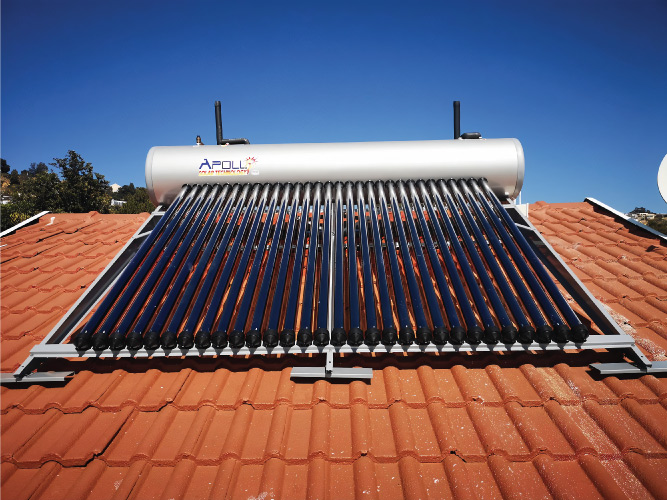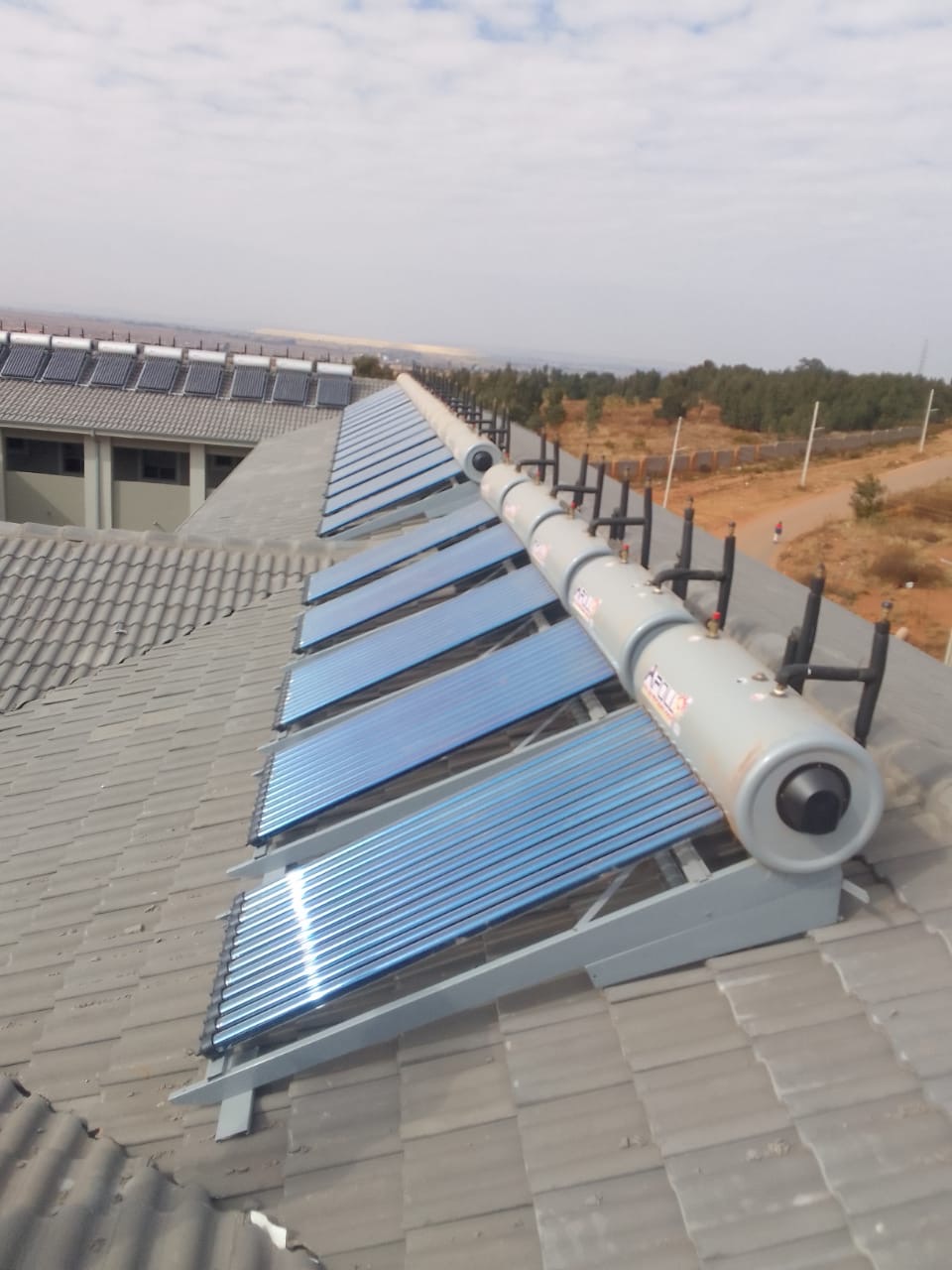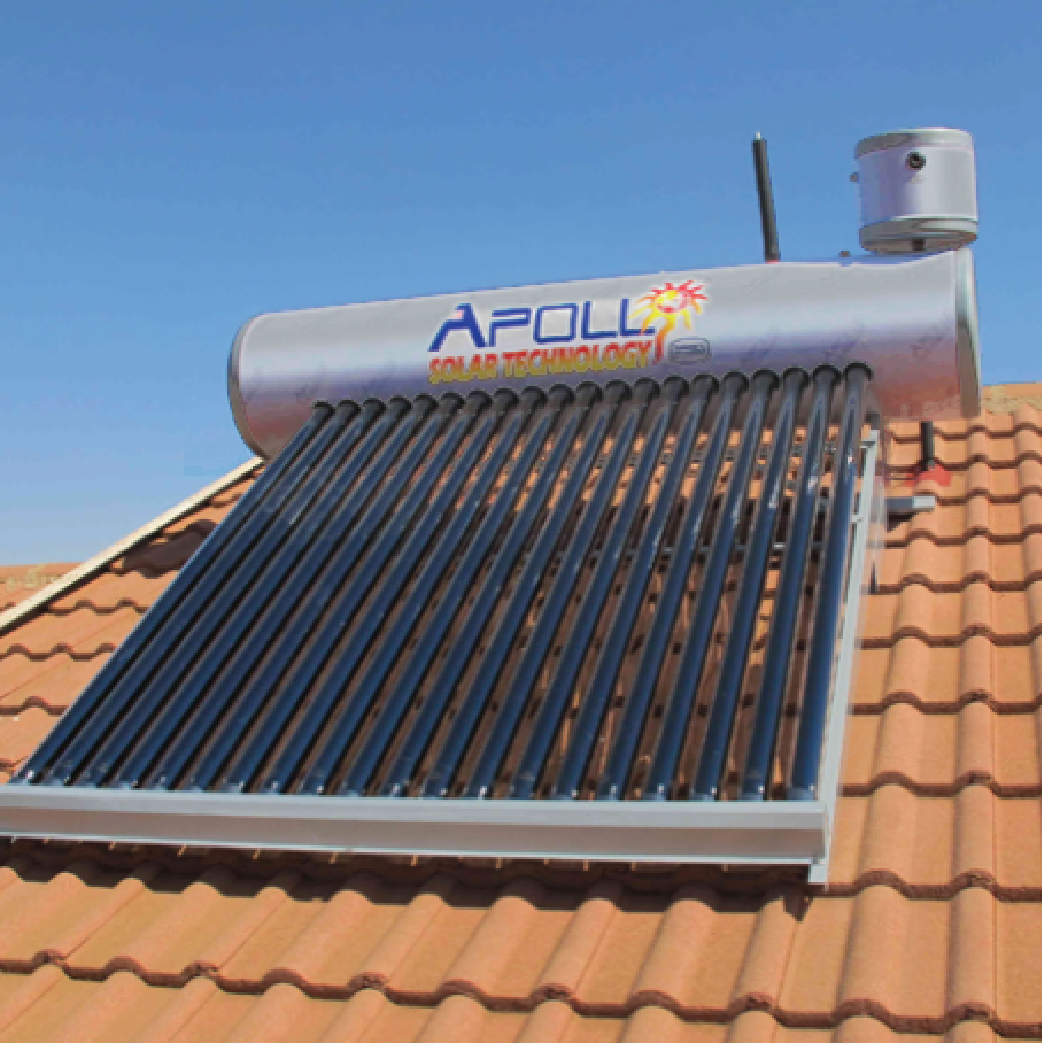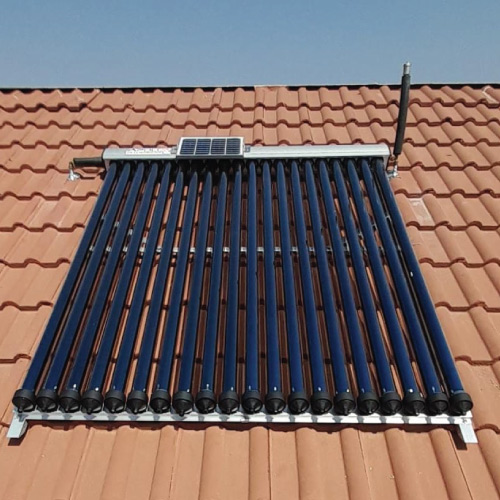
150lt (2 - 3 people) - Stainless Steel - 5 Year Guarantee - High Pressure - SABS Approved

- Sufficient for 2-3 people @ 50lt pppd
- Electricity Saving : 30%-40%
- All new vacuum tube technology
- The tank is manufactured from stainless steel.
- Evacuated tubes are top quality, 2.2 mm thick.
- Tough pre-coated corrosion-resistant zinc outer wrap.
- Tank insulating material is 50mm thick
- High-Pressure Water heater rated at 400kPA.
- Electrical Backup included
- Full Solar Geyser
R 21 950-00 std installation and vat included
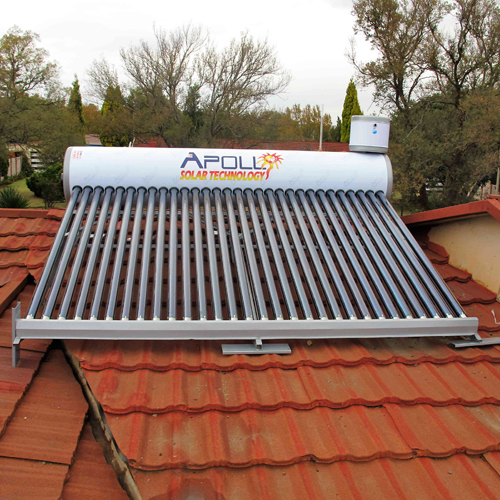
200lt (3 - 4 people) - Stainless Steel - 5 Year Guarantee - SABS Approved - High Pressure

- Sufficient for 3-4 people @ 50lt pppd
- Electricity Saving : 30%-40%
- All new vacuum tube technology
- The tank is manufactured from stainless steel.
- Evacuated tubes are top quality, 2.2 mm thick.
- Tough pre-coated corrosion-resistant zinc outer wrap.
- Tank insulating material is 50mm thick
- High Pressure Water heater rated at 400kPA.
- Electrical Backup included
- Full Solar Geyser
R 25 950-00 std installation and vat included
CONSIDER INCREASING TO A LARGER SOLAR GEYSER INSTEAD OF A STANDARD GEYSER.A Solar Geyser has a limited opportunity (between 09:00 and 15:00) to heat up. It is essential to store a sufficient amount of hot water, heated by solar energy, to minimize reliance on the backup element. The greater the volume of water you can store, the more significant the savings you will realize.
Things to Remember
TRY TO ADJUST THE DAILY SHOWER SCHEDULE TO PREDOMINANTLY EVENINGS.
The solar system requires approximately 5-6 hours of adequate sunlight to raise the geyser temperature to an average of 50-60°C. Ideally, we want the solar system to remain unused during this period, allowing the sun to heat the entire tank effectively. The water, after a full day of sunlight, will reach its highest temperature around 17:00-18:00 and will gradually cool down. If left unused until the next morning, it may lose up to 10°C overnight.
SOLAR GEYSERS MAY STILL REQUIRE ELECTRICAL BACKUP.
We design our systems to optimize savings and minimize the need for element usage as much as possible; however, we experience around 300 sunny days each year. The remaining 65 days are typically overcast and rainy, during which the element will be necessary for assistance. Consequently, we also install a thermostat and timer that can regulate when you wish for the element to provide electrical support.
YOU CAN ADJUST THE TIMER AND THERMOSTAT TO FIT YOUR SCHEDULE.
It is unnecessary to allocate 2 hours of element time for just one shower. Consider fine-tuning the time settings to suit each individual's preferences. If only one person showers in the morning, you may only require 30 minutes of element time for that shower (assuming the geyser was emptied the previous night). You can establish different time settings for various times of the day.
THE SOLAR GEYSER DOES NOT IMPACT YOUR WATER PRESSURE
Solar geysers function as an extension of your plumbing system and do not influence pressure unless a separate Pressure Control Valve is installed for that solar geyser. If you experience low pressure, consider cleaning the screens on the tap outlet, as they may be obstructed by rust and debris. Older homes with galvanized piping may also encounter pressure issues. The addition of a solar geyser cannot cause or resolve these problems, as it merely replaces your conventional geyser and shares the same internal structure.
SHOWER RATHER THAN BATH
A shower typically requires approximately 50 liters of water for a 5-minute duration, while a bath can use up to 100 liters. By appropriately sizing the solar geyser, you can maximize savings. If the solar geyser or panel is undersized, you may need to utilize the heating element, which will diminish savings or lead to a shortage of hot water.
BE AWARE OF THE WEATHER
Occasionally, a day may appear sunny but have scattered clouds. These clouds, particularly during the 11:00 – 13:00 timeframe, can hinder optimal solar absorption. This may impact the overall output of the solar panel and prevent the geyser from reaching its desired temperature. Consequently, the backup heating element may be required to elevate the temperature.
COLD WATER ON A RAINY DAY
Our solar geysers are designed to provide a full tank of hot water for every fully sunny day, assuming usage is minimized during those sunny hours. If you encounter cold water upon the arrival of a rainy day, it is likely that the heating element has not activated. This could be due to the time settings or the geyser switch being turned off. Is the Geyser Switch on the distribution board tripped? Is the timer clock accurate? Are there time settings programmed on the timer? If you had ample hot water on sunny days but not on rainy days, the issue is typically related to the element, timer, or switch.
220V PUMPS VS 12V BATTERY PUMPS
We provide two types of pumps. One is a 220v Pump powered by Eskom, while the other is a 12v Battery-operated pump. The 220v model requires AC 220v (Eskom) power to function and will cease operation during power outages. In contrast, the 12v pump can operate as long as there is sunlight. It utilizes its 12v 7ah battery and 10w PV panel, remaining functional even during power interruptions. It is important to note that the 12v pump system is limited to running the pump alone; if an element is needed, power from Eskom must be restored.
OVERHEATING
We can deactivate or adjust the element, but we cannot regulate the sun. Systems that overheat may cause damage by releasing water through safety or air release valves in an effort to cool down. In severe cases of overheating, vacuum breakers or other valves may fail due to excessive heat accumulation.
In fully solar geysers, a strong stream of water will be expelled from the safety valve. This is a normal operation of that safety valve, and there is no cause for alarm. However, if the valve continues to drip or leak afterward, the rubber seal may be compromised and require replacement.
For conversion systems, the Geyserwise will deactivate the pump to prevent the geyser itself from overheating; however, the solar panel may still accumulate excessive heat. All our systems are equipped with a steam release and safety valve on the panel, designed to release water onto the roof to cool the panel. If they persistently leak afterward, they may need to be replaced.
Load shedding and power outages can adversely impact the excessive heat issue and potentially damage the systems. It is crucial to switch the Geyserwise to holiday mode when not in use for more than a weekend. Additionally, it is highly advisable to cover the panels when outages are anticipated or when not in use for extended periods.
PLACEMENT, SHADE, ORIENTATION
Optimal performance is achieved on a roof that faces directly north, with a 36-degree angle of inclination, and is free from shade. A roof oriented towards the north-east will receive sunlight earlier in the morning but will miss some afternoon sun. Conversely, a north-west facing roof will miss morning sunlight but will enjoy sun later in the afternoon. It is important to note that not facing directly north can lead to a loss of efficiency by 10-15%.
Shade from tall trees or chimneys, even if located in a neighbor's yard, can also reduce efficiency. If this shade affects part of the panel during a critical time of day, it may result in an additional 10-15% decrease in temperature. Consequently, electricity will need to be used more frequently to raise the temperature. This issue can be mitigated by increasing the size of the solar panel, if feasible.
Roofs that face directly east or west can experience a 40-50% reduction in efficiency. Therefore, the solar panel will need to be twice the size.
GEYSERWISE DISPLAY DISCREPANCIES – TEMPERATURE DROP
The temperature sensor is located at the bottom of the Geyser (or sometimes in the middle). Since hot water, similar to air, rises, the display may indicate a temperature that is several degrees lower, and at times, even half the temperature of what is present at the hot water outlet.
The display will only reflect an accurate reading immediately after the heating element has turned off, or right after the sun has ceased to provide heat. Following this, the temperature will gradually decrease, while all the heat continues to ascend to the top.
FROST CONDITIONS
Solar panels are susceptible to freezing in extremely cold weather. To address this, the Geyserwise controller is equipped with a frost function that circulates water from the geyser to warm the panel. It is crucial to ensure that the Geyserwise system is operational. Be aware of loadshedding and power outages to guarantee that an alternative power source is available. 12-volt pumped systems will have their own battery to operate the pump in the event of frost. Ensure that this battery is in good condition. For 220-volt systems, an alternative power source must be connected during loadshedding periods.